Today you get a free short story that doubles as an introduction to The Third Face. Enjoy!
Wednesday, October 17, 2012
Sunday, October 14, 2012
Art Attack
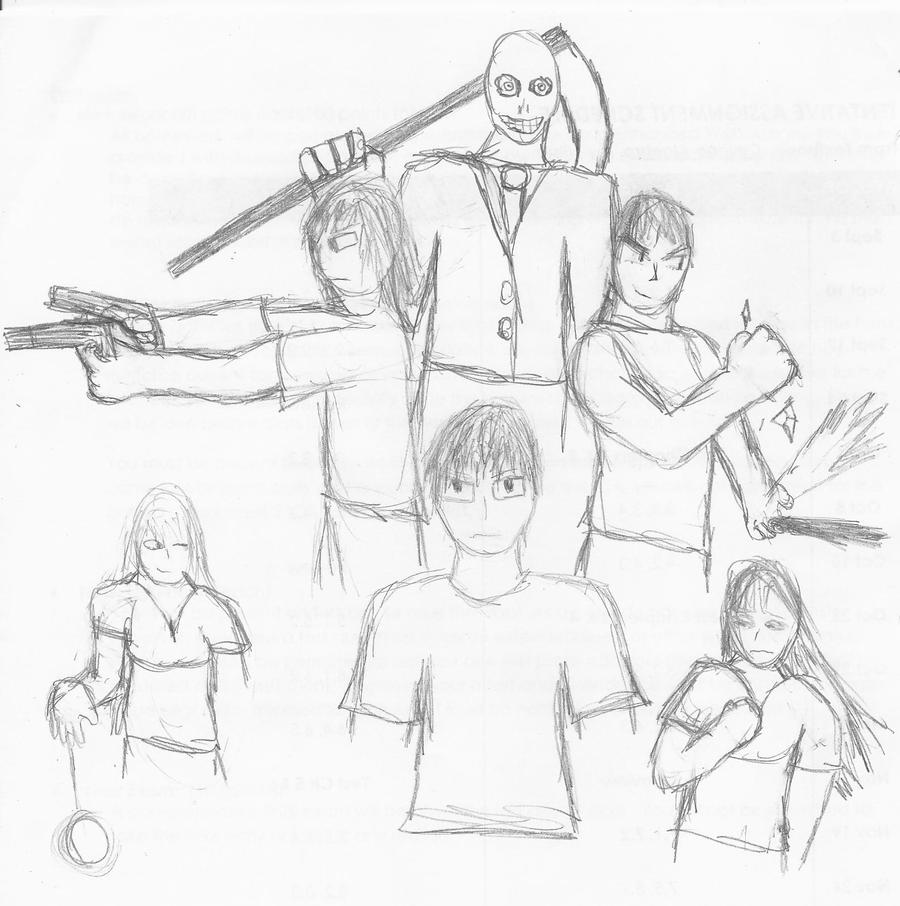
The more strange or abstract that world is, the more it helps to have backup for the words on the page. Usually that means art.
Needless to say, I like drawing. I don't consider myself a great artist, but all the character illustrations that went with the release of The Third Face were mine. To the left here is another drawing of those characters that I did a bit more recently.
Other than this, though, I haven't drawn a thing in months. Time to fix that! There's another major character I want to introduce that way, and a bigger project that would be great to have done by Halloween.
So yes, expect images on blog posts to be a much more common thing from now on.
Friday, October 12, 2012
Review: The Subtle Knife
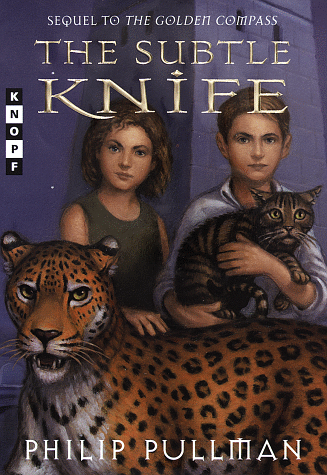
The first book took place in a world where everyone has a daemon, or spiritual animal, alongside them. Witches, shamans, and other strange cultures stand alongside an all-powerful church that worships "The Authority." There are always little names and places that hint at it being very similar to our world, but it feels like a fantastical parallel that Pullman has used in place of Earth.
That all goes out the window when we meet Will, who lives in the real world. Somehow, though, he manages to find a gap in reality that takes him to other worlds, and these "windows" are the focus of this book. Like Lyra, Will has an internal struggle to deal with while he learns the art of using a powerful tool. The call of childhood comforts constantly pulls at his need to fight, to win, to kill in order to survive.
I said in the first book's review that you can kind of ignore the religious undertones in it. That, too, has completely changed. The flight of the Angels and the impending war to destroy The Authority are pulling that into light, and I can expect to see this issue take over completely in The Amber Spyglass.
There are other things that have changed, which I don't like so much. Lyra seems really dumbed down here. While she and Will fight a bit early on, after a while she decides she's just going to do what he says. Where's the strong-willed, clever girl with the savage mind I grew to love in the first book? Other characters acknowledge the change, but only in passing.
Because of this closeness that gets established between the main characters, Pullman likes to jump between them freely, revealing the thoughts of both in the same breath. While this could have to do with Lyra's apparent powers of perception, it's still kind of an unfocused view. I felt a little detached at times, and the narrative, filled with vague thoughts, sometimes bored me even though I was rabidly eager to find out what happened next in this amazing plot.
Still, the things I'm unhappy about are certainly not enough to make me drop a story as daring as this one. One thing that still hasn't changed: Philip Pullman is not afraid to take risks, and that is where his work shines.
Wednesday, October 10, 2012
WeMiSciFan... Fans?
Gah that is hard to try and abbreviate.
What I mean to say is, West Michigan Science Fiction and Fantasy Fans. That's quite a mouthful, isn't it? But it's the only thing that can properly describe the group I recently started over on Facebook. Maybe we should come up with an entirely different name... hmmm...
Anyway, yeah. I invited my friends who fit the description, and they invited some of their friends, and we're definitely off to a good start for a week-old Facebook group that doesn't have another organization behind it. It's nothing fancy and there aren't really any rules or anything, but who needs that stuff anyway? Not unless we see some huge growth in membership...
Still, we're doing quite a few cool things already. The main thing, of course, is plain ol' discussion, where we debate about zombies and bring up our favorite (and least favorite) pieces of sci-fi and fantasy. In addition, there's already at least one piece of writing that a member has put on the table, a science fiction poem he wrote. Other events we're getting started with are Book of the Month and Friday Reads (in which everyone brings up what they're reading on Friday.)
Sound good? It's an open group, and the "West Michigan" part is not a hard border on who and who cannot join. It's more like a phrase that I include so that I'm not trying to be competitive with groups on the national or international level, because this is a smaller group. The point is, anyone is welcome!
If you're interested in joining,
What I mean to say is, West Michigan Science Fiction and Fantasy Fans. That's quite a mouthful, isn't it? But it's the only thing that can properly describe the group I recently started over on Facebook. Maybe we should come up with an entirely different name... hmmm...
Anyway, yeah. I invited my friends who fit the description, and they invited some of their friends, and we're definitely off to a good start for a week-old Facebook group that doesn't have another organization behind it. It's nothing fancy and there aren't really any rules or anything, but who needs that stuff anyway? Not unless we see some huge growth in membership...
Still, we're doing quite a few cool things already. The main thing, of course, is plain ol' discussion, where we debate about zombies and bring up our favorite (and least favorite) pieces of sci-fi and fantasy. In addition, there's already at least one piece of writing that a member has put on the table, a science fiction poem he wrote. Other events we're getting started with are Book of the Month and Friday Reads (in which everyone brings up what they're reading on Friday.)
Sound good? It's an open group, and the "West Michigan" part is not a hard border on who and who cannot join. It's more like a phrase that I include so that I'm not trying to be competitive with groups on the national or international level, because this is a smaller group. The point is, anyone is welcome!
If you're interested in joining,
Monday, October 8, 2012
Back to Reviews: Textbook Edition?!

Because of that, I've been getting a lot of disbelieving stares lately. People are just not prepared to accept what I'm going to say in today's entry.
I love this textbook.
The Practice of Creative Writing by Heather Sellers is the first time in a long while that I've heard something new about writing. This book isn't going to repeat "show don't tell" mantras and pour reasons on your head like it's trying to exorcise you of your bad writing habits. There's no repetitive grammar exercises, either.
Instead, the book is a fast track for a person who's already capable of putting words on the page, to become a real writer. If you're thinking about making something that a lot of people will actually want to read, these are the things you need to know. You're going to see all the pieces that activate the real power in any piece of writing. It shows you how to master energy and tension, where to find the beats in the story, how to make scenes matter and skip the ones that don't.
This textbook is my #1 motivation for going back and rewriting my book, from the beginning. All these techniques will really make it something amazing! It made me really excited to tear the whole thing apart and build it back up again, making it the best it can be.
This book has that kind of power, and I really think any serious writer needs to read it. Where nonfiction goes, it has my highest recommendation.
Saturday, October 6, 2012
More Blog!
As of this writing, the header for this blog begins, "Constantly spewing out ridiculous amounts of information..." Would you say that's right? No? Me neither. I should be more honest, don't you think? Well, rather than change that right now, I think I'm going to try and actually live up to it.
The main reason is actually that I have a lot of things to talk about all of a sudden. I had a tough decision to make on which subject I wanted to blog first--there are at least 2 more important ones nagging at me right now, so expect those pretty soon.
Before this, my goal was "try to get 2 entries a month." That's hardly anything and I still didn't do it, because it didn't seem like anything important was happening. Well, this time I'm going to try to open up to the public a bit more. You'll find the books I'm reading, the writing articles I found helpful, events, and of course, novel updates!
So what's my new goal? Every other day. I'm not going to beat myself up if I don't do it perfectly, or if I happen to be gone every once in a while, but that's the ideal here. I mean, remember when The Third Face was first coming out and I posted every single day--sometimes more than once? If I can do that, I can do this.
Check back soon.
The main reason is actually that I have a lot of things to talk about all of a sudden. I had a tough decision to make on which subject I wanted to blog first--there are at least 2 more important ones nagging at me right now, so expect those pretty soon.
Before this, my goal was "try to get 2 entries a month." That's hardly anything and I still didn't do it, because it didn't seem like anything important was happening. Well, this time I'm going to try to open up to the public a bit more. You'll find the books I'm reading, the writing articles I found helpful, events, and of course, novel updates!
So what's my new goal? Every other day. I'm not going to beat myself up if I don't do it perfectly, or if I happen to be gone every once in a while, but that's the ideal here. I mean, remember when The Third Face was first coming out and I posted every single day--sometimes more than once? If I can do that, I can do this.
Check back soon.
Thursday, October 4, 2012
The Tarot Method
Just the mention of the word "tarot" might make some readers turn away. It's one of those mystical things associated with psychics and gypsies and all that. Let's set aside the debate about whether the cards can tell the future and such. In this post, I'd rather present them as an author's tool.
Every tarot card has a significant amount of symbolism behind it. The name is just a label, and to understand it you have to know a little bit about the picture on the card, the history of the card, and its place in the set. What I'm getting at is, the cards are complex, and they're not always what meets the eye--much like a good character.
So, the tarot method is this: for each main/major character, choose a tarot card that sounds like him or her. Assign that card to the character. Now, whether you know the cards or not, look into the meaning of the card, and apply that meaning to the character.
For example, I might look through the names of cards and say, "Well, Lina certainly acts like (and is sometimes referred to as) a queen. She must be The Empress!" But I know that The Empress is actually a motherly, nurturing figure--nothing like Lina at all! Could that be a hidden side of her that gives her a bit more dimension? Certainly. Bam, character development.
I have 11 major characters, and I assigned them each two cards, one at random, the other through my choice. That leaves me with a lot to consider, perfect for expanding on what's already a complicated story--I have to keep this up for a whole trilogy, after all!
Every tarot card has a significant amount of symbolism behind it. The name is just a label, and to understand it you have to know a little bit about the picture on the card, the history of the card, and its place in the set. What I'm getting at is, the cards are complex, and they're not always what meets the eye--much like a good character.
So, the tarot method is this: for each main/major character, choose a tarot card that sounds like him or her. Assign that card to the character. Now, whether you know the cards or not, look into the meaning of the card, and apply that meaning to the character.
For example, I might look through the names of cards and say, "Well, Lina certainly acts like (and is sometimes referred to as) a queen. She must be The Empress!" But I know that The Empress is actually a motherly, nurturing figure--nothing like Lina at all! Could that be a hidden side of her that gives her a bit more dimension? Certainly. Bam, character development.
I have 11 major characters, and I assigned them each two cards, one at random, the other through my choice. That leaves me with a lot to consider, perfect for expanding on what's already a complicated story--I have to keep this up for a whole trilogy, after all!
Subscribe to:
Posts (Atom)