Continuing from my last look at a few books about writing, I wanted to give you a peek at the latest one I've finished.
Your Path to Publication by Kim Wright is a little book that gives you a truly realistic view of what to expect if you want your book traditionally published. It's a tough world out there, and this isn't going to kid you about that. It's just going to give you all the tips you need. You'll learn where to go to meet an agent or publisher, how to interact with these people, and, of course, the art of the good old-fashioned query. It's brought up a lot of options that I didn't even know existed! Also, it does touch on self-publishing for a chapter, but that's really not what this book is about, and if you're going that route, don't waste your time. Read this book if you're serious about getting a deal with a publisher.
Sorry to give you only a short post after several days without one. Hopefully, this will tide you over until I bring out my news tomorrow.
Showing posts with label reviews. Show all posts
Showing posts with label reviews. Show all posts
Saturday, March 2, 2013
Wednesday, February 20, 2013
Learning
I spend a lot of time looking for more tips about writing. In fact, out of the books I've read each week this year, three of them were just that.
Of course, not everything you read is worthwhile. The three books I bought caught my eye because of their descriptions on Amazon, and I looked through the reviews to see if they were actually as good as they were played up to be. It turned out that just about every book on the subject that I could find got really good reviews, but I couldn't just spend all my time and money on every single one. I had to go with my gut.
What follows is a quick look at each of the books I read, and how I feel about them. A mini-review, if you will, but an honest one, based on my overall experience with writing materials. I've already reviewed one book on writing here in the course of all my other book reviews, but I decided to make this sort of a separate realm.
So, without further ado, let's see what I've got.
Of course, not everything you read is worthwhile. The three books I bought caught my eye because of their descriptions on Amazon, and I looked through the reviews to see if they were actually as good as they were played up to be. It turned out that just about every book on the subject that I could find got really good reviews, but I couldn't just spend all my time and money on every single one. I had to go with my gut.
What follows is a quick look at each of the books I read, and how I feel about them. A mini-review, if you will, but an honest one, based on my overall experience with writing materials. I've already reviewed one book on writing here in the course of all my other book reviews, but I decided to make this sort of a separate realm.
So, without further ado, let's see what I've got.
Wednesday, January 30, 2013
Book Pile Acquired

Writers read. Or at least, we're supposed to. For a long time, I wasn't reading all that much at all. I probably got through a book once every couple of months.
Of course, as you all know, I've resolved to read a book every week this year. My recent slew of orders from both Barnes & Noble and Amazon is going to, at the very least, get me started on that goal. The books are pictured above, in no particular order (although the boxsets do make pretty good bookends).
From left to right:
- The Dark Tower Volumes 1-4 Boxset by Stephen King. I had already read The Gunslinger and loved it, but I didn't own a copy, so it made sense to add these to my collection.
- Inheritance by Christopher Paolini. A conclusion to a great series. I've been meaning to get this for a while.
- A Game of Thrones by George R. R. Martin. Honestly, I bought this for the hype more than anything else.
- The Tribe of One Trilogy by Simon Hawke. In these fantasy novels, a young man with serious mental issues leaves his desert village, where he doesn't belong. Sound familiar? It's a lot like The Third Face. Naturally, I was curious to see how it compares. I'll let you know in my review of the trilogy soon enough.
- The Color of Magic by Terry Pratchett. The Discworld series, recommended by my buddy Duth Olec, is supposed to be the height of comedic fantasy. Where can I go wrong with that?
- Speaker for the Dead by Orson Scott Card. Since I really loved Ender's Game, I of course wanted to check out the next in the series.
- City of Bones by Cassandra Clare. I know nothing about this book, but it won Book of the Month over at the West Michigan Sci-Fi and Fantasy Fans group on Facebook. I think I can trust them for a good recommendation.
- Percy Jackson and the Olympians 5-book Boxset by Rick Riordan. I read The Lightning Thief back in high school, and I enjoyed it a lot, but I don't even remember it very well. This time, I'll read through the whole series.
Sunday, December 30, 2012
Review: Leven Thumps and the Gateway to Foo

Although Leven, the titular character, starts off with a tragic cookie-cutter backstory (an orphan that lives with mean relatives), the laughs are quickly forthcoming. The jokes start with a simple incident of a supposed pest causing a large group of people to panic and knock each other over, but eventually the fate of Foo is resting on a talking toothpick!
Speaking of fate, it plays a huge role in the plot. Things that might normally be considered ridiculous coincidences are always pointed out as the working of fate, which always seems to be on the heroes' side. You can always count on this, so eventually it kind of kills the fear that the characters might fail, and in fact you might find that some of their accomplishments just can't be awarded to them in that light.
One might argue that this is completely necessary, though, because the characters have more than just the villain to worry about. Leven spends the entire book beset by shadows that convince him that it's not worth it to join this cause--either because he can't help, or because it's not justified. The other characters spend as much time dealing with this as they do on their quest, if not more. Although his doubts don't really originate in his own mind, it's still one of the stronger character arcs I've read.
Reading Leven Thumps is a lot like watching a children's cartoon or anime. If you can stop trying to make sense of it and just enjoy the ride, there's a lot of fun to be had.
Sunday, December 23, 2012
Review: Ender's Game
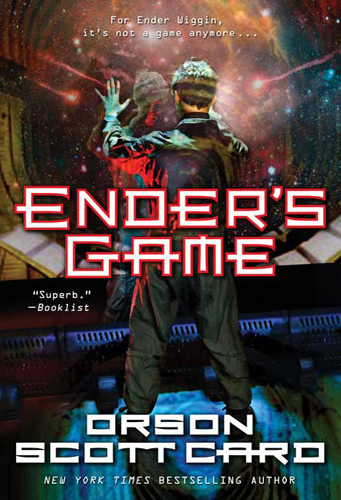
Ender is chosen, or perhaps created, by the international government's search for a fleet commander. Even in normal school, they single him out until he has to get in fights with other kids in order to make it. But the real test comes when he's only six years old, when they send him out into space to join Battle School.
There, Ender advances far faster than anyone else ever has, rarely getting even a small taste of failure. The teachers are constantly messing with things to push him to his limits. Not only does he improve himself, but he teaches an entire generation of students a whole new way of thinking that vastly improves their skills. With his genius he starts to change the nature of the no-gravity shootout games that determine students' rankings.
And it's in these games that you start to really respect Orson Scott Card's writing. At first he skims through situations because these are no challenge for Ender, but even there you can see the beginnings of strategy. In fact, the things you see Ender learning make you wonder if Card hasn't spent a bit of time in space himself! If battles seem a bit far away, it's because you're looking at them through a tactician's eyes.
This is to say nothing of the big pile of moral dilemmas and other thought-provoking questions that are hidden in the text. Is Ender anything like his calculating, pain-loving brother Peter? And if so, is it because of who he is, or because Battle School made him that way? And most importantly, is it right to want to get rid of the invading alien force at all?
Card purposely leaves all of these questions without a clear answer, and that only adds to the depth of this work. It gives an effect that I rarely see in any other book: it has that "literary" quality to it, but it's also a fast-paced adventure that keeps you reading.
So there's definitely a good reason Ender's Game is the science fiction classic that it's considered to be. It's the Book of the Month for December 2012 over at West Michigan Sci-Fi and Fantasy Fans, if that means anything. If you haven't read it yet, give it a shot--you might start to look at things in a new way.
Sunday, December 9, 2012
Review: The Amber Spyglass

Although the first two books impressed me, in light of this book they served as mere introductions to it. The jump in length is appropriate, because there's so much more going on now! Now that we've met Will and Lyra, and gotten a good idea of the concepts underlying this world, it's time for a real struggle.
As predicted, the philosophical undertones of this work are pretty strong. Pullman explores the afterlife and the intelligence of matter, among other things. He even presents us with a world in which four-legged creatures have a diamond-shaped body structure, and birds have one wing on the front and the other on the back!
I was much happier with the character development here. Both characters are starting to learn what they need to do, and you can see them both in terms of each other. Their relationship is really what drives the story, alongside the twisting intrigue of the adults in the story, particularly Mrs. Coulter, who is as untrustworthy to everyone as ever.
Pullman continued to keep me hooked by pushing imagination to its limits without making anything feel the least bit implausible. I have to say, I really was not expecting the direction this story ended up going in. While everything called for the characters to hurry up and jump to the final battle, they defied that and took a different route entirely, one that kept me guessing right until the end.
Now I'm going to go a little more in-depth about this here, but be warned: the rest of this review will spoil the book!
Friday, October 12, 2012
Review: The Subtle Knife
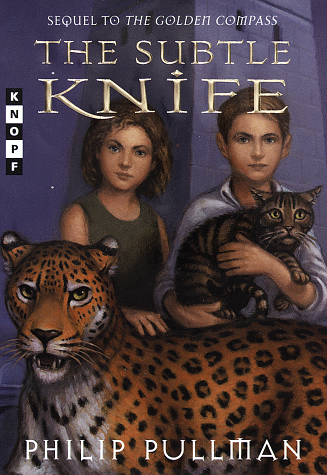
The first book took place in a world where everyone has a daemon, or spiritual animal, alongside them. Witches, shamans, and other strange cultures stand alongside an all-powerful church that worships "The Authority." There are always little names and places that hint at it being very similar to our world, but it feels like a fantastical parallel that Pullman has used in place of Earth.
That all goes out the window when we meet Will, who lives in the real world. Somehow, though, he manages to find a gap in reality that takes him to other worlds, and these "windows" are the focus of this book. Like Lyra, Will has an internal struggle to deal with while he learns the art of using a powerful tool. The call of childhood comforts constantly pulls at his need to fight, to win, to kill in order to survive.
I said in the first book's review that you can kind of ignore the religious undertones in it. That, too, has completely changed. The flight of the Angels and the impending war to destroy The Authority are pulling that into light, and I can expect to see this issue take over completely in The Amber Spyglass.
There are other things that have changed, which I don't like so much. Lyra seems really dumbed down here. While she and Will fight a bit early on, after a while she decides she's just going to do what he says. Where's the strong-willed, clever girl with the savage mind I grew to love in the first book? Other characters acknowledge the change, but only in passing.
Because of this closeness that gets established between the main characters, Pullman likes to jump between them freely, revealing the thoughts of both in the same breath. While this could have to do with Lyra's apparent powers of perception, it's still kind of an unfocused view. I felt a little detached at times, and the narrative, filled with vague thoughts, sometimes bored me even though I was rabidly eager to find out what happened next in this amazing plot.
Still, the things I'm unhappy about are certainly not enough to make me drop a story as daring as this one. One thing that still hasn't changed: Philip Pullman is not afraid to take risks, and that is where his work shines.
Monday, October 8, 2012
Back to Reviews: Textbook Edition?!

Because of that, I've been getting a lot of disbelieving stares lately. People are just not prepared to accept what I'm going to say in today's entry.
I love this textbook.
The Practice of Creative Writing by Heather Sellers is the first time in a long while that I've heard something new about writing. This book isn't going to repeat "show don't tell" mantras and pour reasons on your head like it's trying to exorcise you of your bad writing habits. There's no repetitive grammar exercises, either.
Instead, the book is a fast track for a person who's already capable of putting words on the page, to become a real writer. If you're thinking about making something that a lot of people will actually want to read, these are the things you need to know. You're going to see all the pieces that activate the real power in any piece of writing. It shows you how to master energy and tension, where to find the beats in the story, how to make scenes matter and skip the ones that don't.
This textbook is my #1 motivation for going back and rewriting my book, from the beginning. All these techniques will really make it something amazing! It made me really excited to tear the whole thing apart and build it back up again, making it the best it can be.
This book has that kind of power, and I really think any serious writer needs to read it. Where nonfiction goes, it has my highest recommendation.
Wednesday, April 20, 2011
Review: Elemental Sacrifices - The Gathering
Have you ever wanted to read a book about a mute kid with poison for spit? How about an army of monsters made out of sand? Or maybe a vegetarian girl with a hair obsession and a lifetime of combat training?
Well, you probably haven't really given it much thought. But if, upon considering it just now, you said yes, you'd probably like to know more--and even if you said no, well, maybe I can convince you anyway.
Elemental Sacrifices: The Gathering follows an ancient-magical-orb-turned-girl named Chloe. Along with her snotty sister, she sets off to escape monsters and angry villagers alike, to see a boy so thoroughly attractive that even I (a straight male) find him sexy, and, of course, to find the secrets of her own origins.
The journey is punctuated with vivid, stunning battles with various fiends, as well as with genuine, hilarious dialogue among the amazingly strong cast of characters that this deep world has to offer. Reading it is not just interesting or suspenseful, but truly fun.
Excited yet? I definitely am! I'm not sure where the author is in the production of it, but I'm sure she can do a lot more with a little support for her work--it goes a long way, to say the least.
Well, you probably haven't really given it much thought. But if, upon considering it just now, you said yes, you'd probably like to know more--and even if you said no, well, maybe I can convince you anyway.
Elemental Sacrifices: The Gathering follows an ancient-magical-orb-turned-girl named Chloe. Along with her snotty sister, she sets off to escape monsters and angry villagers alike, to see a boy so thoroughly attractive that even I (a straight male) find him sexy, and, of course, to find the secrets of her own origins.
The journey is punctuated with vivid, stunning battles with various fiends, as well as with genuine, hilarious dialogue among the amazingly strong cast of characters that this deep world has to offer. Reading it is not just interesting or suspenseful, but truly fun.
Excited yet? I definitely am! I'm not sure where the author is in the production of it, but I'm sure she can do a lot more with a little support for her work--it goes a long way, to say the least.
Wednesday, January 12, 2011
Review: The Golden Compass

I don't know why I did. The concept didn't interest me, and I felt that I already knew enough about it by having watched those commercials for the movie when it came out a few years ago. I thought it was too childish for me. Who wouldn't come to that conclusion after seeing a little girl ride a polar bear?
I regret that first impression.
Okay, I probably still won't watch the movie. But that's because I suspect the movie itself of being at fault for my original bias. It's hard to trust movies anyway, especially having been hit pretty hard back at the infamous Eragon fiasco.
The book, though. Wow. For a popular classic from the 90's, it's surprisingly deep and dark. Turns out just because the main character is a little kid doesn't mean the reader has to be. In hindsight, I should have known that all too well.
What I liked about it was that it did not shrink from the subjects of torture, deception, and even religion. The latter, luckily enough, is enough in the background that a person who'd rather not deal with religious debate can pretty much ignore it.
Anyway, Pullman puts us deep into the mind of a girl living on the line between civilization and savagery. The primal force is what pushes this story along, but the cleverness of a sophisticated mind shines through. We get to see genius lying and the science of a sort of psychic reading that the main character, Lyra, is able to perform. It gives her a lot of answers, but only enough to build anticipation for what will happen next in this fast-paced action.
Okay, I promise a better review next time. At this point I really just wanted to put something on the page for people to see. Anyway, if you like your reading with a dash of mysticism, a bit of eerieness, and some tastefully executed violence, there's no reason not to pick up The Golden Compass. Unlike most literary classics, this one made it big for a reason: it's really good stuff.
Subscribe to:
Posts (Atom)