I've got to review more books in this blog. In two years all I've reviewed were a textbook, and the first two books in the His Dark Materials trilogy. And only today will I get to the final book in Phillip Pullman's trilogy: The Amber Spyglass.
Although the first two books impressed me, in light of this book they served as mere introductions to it. The jump in length is appropriate, because there's so much more going on now! Now that we've met Will and Lyra, and gotten a good idea of the concepts underlying this world, it's time for a real struggle.
As predicted, the philosophical undertones of this work are pretty strong. Pullman explores the afterlife and the intelligence of matter, among other things. He even presents us with a world in which four-legged creatures have a diamond-shaped body structure, and birds have one wing on the front and the other on the back!
I was much happier with the character development here. Both characters are starting to learn what they need to do, and you can see them both in terms of each other. Their relationship is really what drives the story, alongside the twisting intrigue of the adults in the story, particularly Mrs. Coulter, who is as untrustworthy to everyone as ever.
Pullman continued to keep me hooked by pushing imagination to its limits without making anything feel the least bit implausible. I have to say, I really was not expecting the direction this story ended up going in. While everything called for the characters to hurry up and jump to the final battle, they defied that and took a different route entirely, one that kept me guessing right until the end.
Now I'm going to go a little more in-depth about this here, but be warned: the rest of this review will spoil the book!
Constantly spewing ridiculous amounts of information about my life and my work as a science fiction and fantasy writer. Keep up with my new novels, what I've been reading, and more!
Showing posts with label His Dark Materials. Show all posts
Sunday, December 9, 2012
Friday, October 12, 2012
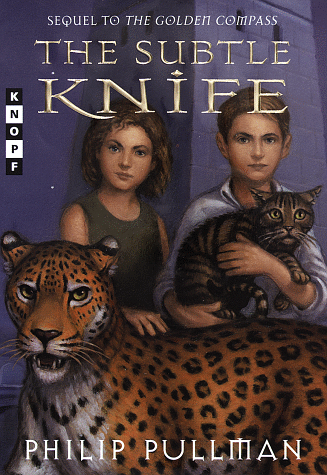
Review: The Subtle Knife
One of my first ever blog posts was when I reviewed Philip Pullman's The Golden Compass. Why it's taken me almost two years to get to and read through the sequel, The Subtle Knife, is anyone's guess.
The first book took place in a world where everyone has a daemon, or spiritual animal, alongside them. Witches, shamans, and other strange cultures stand alongside an all-powerful church that worships "The Authority." There are always little names and places that hint at it being very similar to our world, but it feels like a fantastical parallel that Pullman has used in place of Earth.
That all goes out the window when we meet Will, who lives in the real world. Somehow, though, he manages to find a gap in reality that takes him to other worlds, and these "windows" are the focus of this book. Like Lyra, Will has an internal struggle to deal with while he learns the art of using a powerful tool. The call of childhood comforts constantly pulls at his need to fight, to win, to kill in order to survive.
I said in the first book's review that you can kind of ignore the religious undertones in it. That, too, has completely changed. The flight of the Angels and the impending war to destroy The Authority are pulling that into light, and I can expect to see this issue take over completely in The Amber Spyglass.
There are other things that have changed, which I don't like so much. Lyra seems really dumbed down here. While she and Will fight a bit early on, after a while she decides she's just going to do what he says. Where's the strong-willed, clever girl with the savage mind I grew to love in the first book? Other characters acknowledge the change, but only in passing.
Because of this closeness that gets established between the main characters, Pullman likes to jump between them freely, revealing the thoughts of both in the same breath. While this could have to do with Lyra's apparent powers of perception, it's still kind of an unfocused view. I felt a little detached at times, and the narrative, filled with vague thoughts, sometimes bored me even though I was rabidly eager to find out what happened next in this amazing plot.
Still, the things I'm unhappy about are certainly not enough to make me drop a story as daring as this one. One thing that still hasn't changed: Philip Pullman is not afraid to take risks, and that is where his work shines.
The first book took place in a world where everyone has a daemon, or spiritual animal, alongside them. Witches, shamans, and other strange cultures stand alongside an all-powerful church that worships "The Authority." There are always little names and places that hint at it being very similar to our world, but it feels like a fantastical parallel that Pullman has used in place of Earth.
That all goes out the window when we meet Will, who lives in the real world. Somehow, though, he manages to find a gap in reality that takes him to other worlds, and these "windows" are the focus of this book. Like Lyra, Will has an internal struggle to deal with while he learns the art of using a powerful tool. The call of childhood comforts constantly pulls at his need to fight, to win, to kill in order to survive.
I said in the first book's review that you can kind of ignore the religious undertones in it. That, too, has completely changed. The flight of the Angels and the impending war to destroy The Authority are pulling that into light, and I can expect to see this issue take over completely in The Amber Spyglass.
There are other things that have changed, which I don't like so much. Lyra seems really dumbed down here. While she and Will fight a bit early on, after a while she decides she's just going to do what he says. Where's the strong-willed, clever girl with the savage mind I grew to love in the first book? Other characters acknowledge the change, but only in passing.
Because of this closeness that gets established between the main characters, Pullman likes to jump between them freely, revealing the thoughts of both in the same breath. While this could have to do with Lyra's apparent powers of perception, it's still kind of an unfocused view. I felt a little detached at times, and the narrative, filled with vague thoughts, sometimes bored me even though I was rabidly eager to find out what happened next in this amazing plot.
Still, the things I'm unhappy about are certainly not enough to make me drop a story as daring as this one. One thing that still hasn't changed: Philip Pullman is not afraid to take risks, and that is where his work shines.
Wednesday, January 12, 2011
Review: The Golden Compass
As I sit down blearily in front of my computer, it's hard to believe that just a week ago life wasn't that hard. Back then, the only thing I had to do was read some books. Well, I'm glad that one of the ones I picked up was The Golden Compass.
I don't know why I did. The concept didn't interest me, and I felt that I already knew enough about it by having watched those commercials for the movie when it came out a few years ago. I thought it was too childish for me. Who wouldn't come to that conclusion after seeing a little girl ride a polar bear?
I regret that first impression.
Okay, I probably still won't watch the movie. But that's because I suspect the movie itself of being at fault for my original bias. It's hard to trust movies anyway, especially having been hit pretty hard back at the infamous Eragon fiasco.
The book, though. Wow. For a popular classic from the 90's, it's surprisingly deep and dark. Turns out just because the main character is a little kid doesn't mean the reader has to be. In hindsight, I should have known that all too well.
What I liked about it was that it did not shrink from the subjects of torture, deception, and even religion. The latter, luckily enough, is enough in the background that a person who'd rather not deal with religious debate can pretty much ignore it.
Anyway, Pullman puts us deep into the mind of a girl living on the line between civilization and savagery. The primal force is what pushes this story along, but the cleverness of a sophisticated mind shines through. We get to see genius lying and the science of a sort of psychic reading that the main character, Lyra, is able to perform. It gives her a lot of answers, but only enough to build anticipation for what will happen next in this fast-paced action.
Okay, I promise a better review next time. At this point I really just wanted to put something on the page for people to see. Anyway, if you like your reading with a dash of mysticism, a bit of eerieness, and some tastefully executed violence, there's no reason not to pick up The Golden Compass. Unlike most literary classics, this one made it big for a reason: it's really good stuff.
I don't know why I did. The concept didn't interest me, and I felt that I already knew enough about it by having watched those commercials for the movie when it came out a few years ago. I thought it was too childish for me. Who wouldn't come to that conclusion after seeing a little girl ride a polar bear?
I regret that first impression.
Okay, I probably still won't watch the movie. But that's because I suspect the movie itself of being at fault for my original bias. It's hard to trust movies anyway, especially having been hit pretty hard back at the infamous Eragon fiasco.
The book, though. Wow. For a popular classic from the 90's, it's surprisingly deep and dark. Turns out just because the main character is a little kid doesn't mean the reader has to be. In hindsight, I should have known that all too well.
What I liked about it was that it did not shrink from the subjects of torture, deception, and even religion. The latter, luckily enough, is enough in the background that a person who'd rather not deal with religious debate can pretty much ignore it.
Anyway, Pullman puts us deep into the mind of a girl living on the line between civilization and savagery. The primal force is what pushes this story along, but the cleverness of a sophisticated mind shines through. We get to see genius lying and the science of a sort of psychic reading that the main character, Lyra, is able to perform. It gives her a lot of answers, but only enough to build anticipation for what will happen next in this fast-paced action.
Okay, I promise a better review next time. At this point I really just wanted to put something on the page for people to see. Anyway, if you like your reading with a dash of mysticism, a bit of eerieness, and some tastefully executed violence, there's no reason not to pick up The Golden Compass. Unlike most literary classics, this one made it big for a reason: it's really good stuff.
Subscribe to:
Posts (Atom)